The 2026 SFSU Student AI Awards celebrate original student projects that thoughtfully explore, apply, critique or innovate with AI.
View all of the submissions from the first annual SFU Student AI Awards.
2026 Category Winners
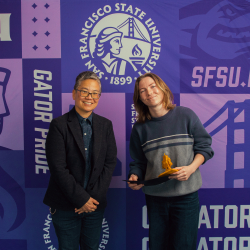
Encoding Inequality: How Social Prejudice is Passed into AI
Claudia Wormley
Category: Exploring Societal Impacts and Perspectives
Artificial intelligence systems often inherit and amplify social biases embedded in historical data, resulting in discriminatory outcomes that disproportionately harm marginalized groups. Because AI models learn from human generated data shaped by unequal social structures, bias is not an anomaly but a systemic risk. As AI systems advance with increasing autonomy and opacity, this risk intensifies: unchecked models threaten to become authoritative information sources in which the origins of bias are obscured, making discriminatory patterns increasingly
difficult, if not impossible, to identify, challenge, and remove.
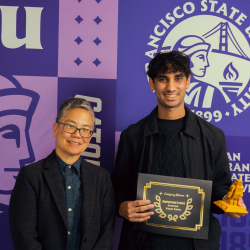
Shipyard
Kareem Amin
Category: Innovation - Choose Your Topic
Shipyard is a hackathon management platform built to improve submissions, judging, and event operations. Since launch, it has been used by over 1,000 users and supported 9 hackathons, including SFSU's annual hackathon, SFHacks. I used AI throughout nearly every stage of building and growing Shipyard. For most of this project, I have worked as essentially a one-person team, occasionally bringing in outside help when needed. Because of that, AI became a major force multiplier for me. It helped me work more efficiently across product development, design, operations, outreach, and strategy, especially while working with limited time and limited prior experience building a platform like this.
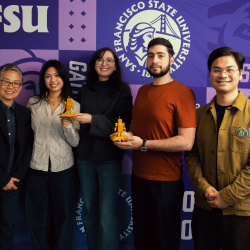
BlueCore AI
Kataliya Sungkamee, Giovanna Gomez, John Tatlonghari, Arman Daghbashyan
Category: Problem Solving with AI
BlueCore is an AI-powered paperwork automation platform designed to reduce the cognitive and administrative burden placed on workers in high-stakes environments. Through human-centered research, including interviews with maritime operators, engineers, and industry professionals, we identified a consistent pattern: paperwork does not replace work - it extends it. Our objective was to redesign documentation systems using AI - not simply to digitize paperwork, but to eliminate unnecessary repetition, reduce cognitive load, and create a more intuitive, human-centered experience of work.
Pitch videos by category
Exploring Societal Impacts and Perspectives
VilloroBot
Ivan Garza
VilloroBot is a dual-repository educational AI agent deployed on Discord. It consists of a headless ‘brain’ project employing an Agentic ReAct (Reason + Act) loop and a client-layer Discord bot. By deploying on Discord, VilloroBot
functions as a "public philosopher" that an entire class can interact with at once. This creates a living history of philosophical inquiry where students can learn not only from the bot’s responses but from the questions and dialogues of their peers.
Ai and Becoming 'Less' Yourself
Mary Antoinette Weigel
Many unskippable YouTube ads in recent months have tried to convince me that utilizing this or that AI system will help me become my “best” self. In a culture focused so heavily on productivity and optimization, it is no surprise that many feel the best new technologies can be used to help people “level up” in ways they could not have on their own. In this paper, I argue that using large language models (LLM) for self-concept forming activities makes us “less” ourselves.
Policy Proposal for Greater U.S. Intervention: Use of AI
Anna Saez
This project is an AI policy recommendation urging for the US government to design a new federal AI regulation office meant to balance innovation with safety, security, and ethics. [This project results in a memo that is] meant to critically examine AI’s impact on society as well as explore how AI can be used ethically in the future with intervention from the US Government.
Innovation - Choose Your Topic
ATHENA
Isaiah Bailen
ATHENA is a wearable, AI-powered tactical assistant built entirely for first responders. It is mounted onto the user's forearm for immediate, hands-free access that eliminates fumbling for a phone, tangled radio device, or chest-mounted tablet. ATHENA provides real-time geographic and tactical awareness from the local map view to state and national emergency operations. What makes ATHENA different from other devices is what the AI does to assist the user in making decisions.
The Unsilenced Debate: Live Socratic Dialog with Historical Thinkers
Travis Holasek
An AI system that lets a user debate a simulated historical figure, not to recite facts, but to stress-test the user’s own beliefs through rigorous, sourced counterargument.
Bit-Chat: Client-Side LLM Inference in the Browser via WebGPU
Pierre Guirguis
Bit-Chat is a web app that runs a quantized large language model entirely in the user's browser using WebGPU — no server, no API key, no account required. Open the link, the model downloads once and caches locally, and you chat with it at 30-40 tokens per second. The project demonstrates that meaningful AI inference can happen entirely on-device, making it free, private, and accessible to anyone with a modern browser.
AutoStockAnalyzer: An AI Driven Equity Forecasting and Signal Intelligence
Aarnav Saxena
AutoStockAnalyzer is an AI-powered equity forecasting system designed to support mid- to long-term investment decisions across the S&P 500. The system operates on a daily cycle, beginning with automated data ingestion from yfinance (price and volume history), the FRED API (GDP, CPI, interest rates), and public filings for congressional and insider trading disclosures. At its core, the system runs a 12-method forecasting ensemble on quarterly stock data.
AgentFlow: An AI-Native Social Network for the Creator Economy
Jose Cruz Campos Rodriguez
Today's creator economy is fragmented. Creators juggle multiple disconnected platforms — social media, content distribution, fan engagement, analytics — with no intelligent layer connecting them. Existing tools are passive; they store and display content, but they don't think, adapt, or act on the creator's behalf. As AI agents become increasingly capable, there is a growing opportunity to build infrastructure where agents are first-class participants — not add-ons — in the creator workflow. AgentFlow addresses this gap by designing a social network where AI agents automate,
personalize, and scale the creator experience from the ground up.
Problem Solving with AI
Scholar AI: An AI Assistive Study Tool
Kiran Khatri and Keith Tang
ScholarAI is an AI-powered study assistant designed to help students better understand their course materials. Students can upload documents such as lecture slides, PDFs, and notes, and the system allows them to ask questions directly about the uploaded content.
Social Robots to Support Rehabilitation Goal Achievement through Personalized Motivational Strategies
Shivangi Narayan, Jason Martin Avina, Lizbeth Paisano, Aloe Alvarez, Osiel Enrique Sales, Alyssa Kubota
In this project, we demonstrate a goal achievement framework that aims to support users in achieving their real-world goals across a longitudinal rehabilitation setting. The system uses Retrieval-Augmented Generation (RAG), combined with the ASER (activities, states, events, and their relations) commonsense knowledge graph, and knowledge graph attention network (KGAT)-based reasoning to enable robots to understand everyday contexts and provide meaningful guidance to users.
Agentic AI for Career Pathway Planning
Fayeeza Shaikh
At SF State, advisors spend 30 to 45 minutes per student manually reviewing Degree Progress Reports. That time could be used for more meaningful guidance. As a master's student in Data Science and AI and a graduate advisor, I wanted to build something that solves a problem I face every day. [This] project is an AI prototype that automates the first step of this process. Students upload their DPR PDF, and four AI agents process it one after another. The system reviews course history, anonymizes student data to follow FERPA rules, creates a semester-by-semester graduation plan that considers prerequisites, explains each recommendation clearly, and matches completed courses to career paths with scores and skill gap analysis.
Anchor: An AI-Driven Financial Navigator for Students and New Graduates
Natalie Mason
The Financial Complexity of Higher Education The path through university and into a professional career is increasingly a financial minefield. For current students, navigating the "New Era of Financial Realism" in 2026, marked by shifting FAFSA regulations and new federal loan caps, creates constant uncertainty. For new graduates, the "Post-Grad Financial Cliff" is even steeper. In 2016, when I first moved to San Francisco, I faced a reality many SFSU students know well: more than 50% of my after tax income was consumed by housing alone. Standard budgeting apps are insufficient because they are reactive. They tell users what they already spent but fail to provide the proactive guidance needed to navigate debt, high rent, and long term stability. Anchor is designed to help both current students and new grads find stability, security, and stay grounded while navigating an expensive city.
SafeRead: A Multi-Layer AI Pipeline for Scam & Phishing Detection with Explainable Output
Sai Akshaya Pujari and Rushda Shaikh
SafeRead is a multi-layer AI pipeline that analyzes suspicious messages and links, identifies psychological manipulation tactics, and returns a plain-language risk report designed for immigrants and non-native English speakers — the most targeted and least served group in digital safety.
Sieve
Benjamin Klein
AI decision systems today force a choice between capability and transparency. This project starts from a transparent, explainable scoring system, and uses AI to automate the construction and tuning that used to require dedicated expert effort to get right.
LastMile-Sec
Will Young
Vulnerability and penetration tests generate massive, noisy reports filled with completely generic remediation advice. This creates a severe operational bottleneck, forcing senior engineers to burn countless hours of labor manually reviewing findings, researching vendor documentation, and translating generic alerts into custom solutions. Born from real-world operational bottlenecks experienced at my job working for a Managed Service Provider, LastMile-Sec addresses this inefficiency as an agentic, four-stage workflow that processes noisy security telemetry and routes it into engineer-ready operational tasks.
DocuMind
Aniruddha Madhusudan Dhir
DocuMind is an AI-powered document intelligence agent that automates the processing, organization, and understanding of unstructured files like PDFs using OCR and large language models. It extracts key information, structures data, and streamlines workflows to save time and reduce manual effort.